


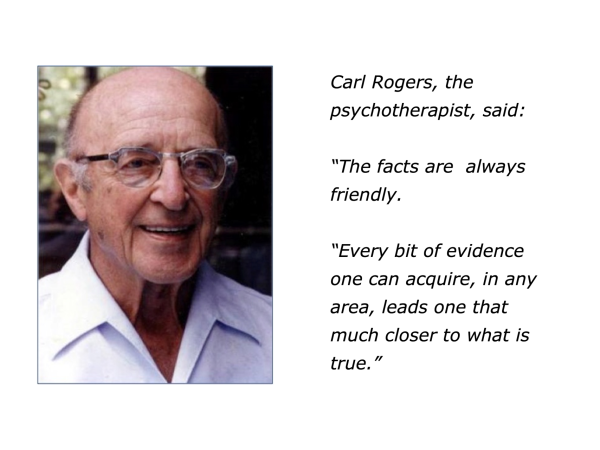
Carl Rogers believed that people grew by facing reality. We should welcome information, he said, even if the new evidence shows that our previous views were mistaken.
Whatever the revelation, the facts are friendly. Bearing this in mind, it important to keep reading reality. Different people do this in different ways in different situations.
Imagine, for example, that you lead a team and are aiming to manage a challenging situation. Bearing this in mind, you may explore the following themes.
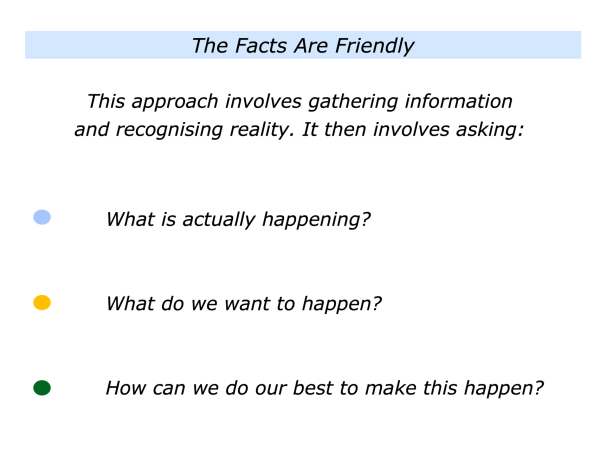
Let’s return to your own life and work. Imagine you want to follow elements of this approach when facing a challenging situation. If appropriate, you can focus on the following themes.
You can gather information by
recognising the facts are friendly
Gather information with an open mind, we are told, even though this might challenge your present views. This can be difficult, because it highlights a key issue.
Do we believe what we see or do we see what we believe?
People sometimes have a paradigm – a way of looking at the world – that means they only focus on things that support their present position.
As we know, this is called confirmation bias. This can be reassuring for them, but sometimes it means they refuse to read reality. Such an approach can be dangerous for them and also for other people.
Peak performers are positive realists in the fields where they excel. They have a positive attitude but also quickly read reality. This enables them to see patterns and anticipate what might happen.
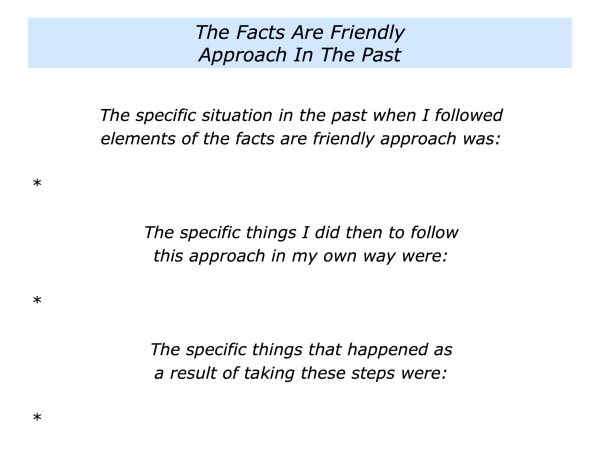
Looking back on your life, can you think of a difficult situation where you adopted the approach that the facts were friendly? You may have lost a client, been concerned about an illness or faced another challenge.
Whatever the situation, you wanted to know the truth. How did you keep an open mind, even though you might have been going through difficulties? How did you gather the data? How did you then use the information to move forward?
If you wish, try tackling the exercise on this theme. This invites you to complete the following sentences.
You can make decisions by
recognising the facts are friendly
Let’s assume you know the facts about a tough situation. The next step is to decide your way forward. As we know. one approach is to use the Three C model for making decisions. This involves focusing on clarity, creativity and concrete results.
Clarity
Looking at the challenge you face, what are the real results you want to achieve? You may want to achieve several aims. If so, list these in order of priority. What are the things you can control in the situation?
Creativity
The next step is to focus on creativity. What are the choices you have for trying to achieve the goals? What are the consequences – the pluses and minuses of each option? Are there any other potential creative solutions?
Concrete Results
What is the route – or combination of routes – you want to follow? How can you translate your chosen route into action? How can you get some early successes? How can you encourage yourself on the journey?
Good decision makers often base their decisions on the consequences of the options, rather than the options themselves. Such people can therefore be said to choose the consequences. They then aim to build on the pluses and minimise the minuses.
Let’s consider a tough example. Imagine that you contract a life threatening illness. You will start by gathering lots of information. This may involve scouring the web, reading and consulting with experts. You will then go into decision making mode.
Clarity will be the first step. What are the real results you want to achieve? You may want to live as long as possible, whatever the treatment. Or maybe you prefer to have less invasive treatment and a reasonable quality of life.
Gathering information, you will explore the various options. These may include mainstream or alternative treatments. You will also look at the consequences.
You may be able to prolong your life for 3 years but with difficult side effects. Alternatively, without extensive treatment, you may be able to live for 18 months, with most pain coming near death.
Facing the facts may not at first sight appear friendly. But it is vital to get as much information as possible. This will enable you to consider the various choices, consequences and other creative solutions. You will then be in a better position to choose your way forward.
You can keep doing reality checks by
recognising that the facts are friendly
Imagine that you have embarked on pursuing your chosen route. You will do your best to work towards your chosen goals.
It will also be important to focus on facts. Bearing this in mind, how can you keep doing reality checks: a) to see what is working and do it more; b) to find solutions to things that are not working? How can you do everything possible to achieve your goals?
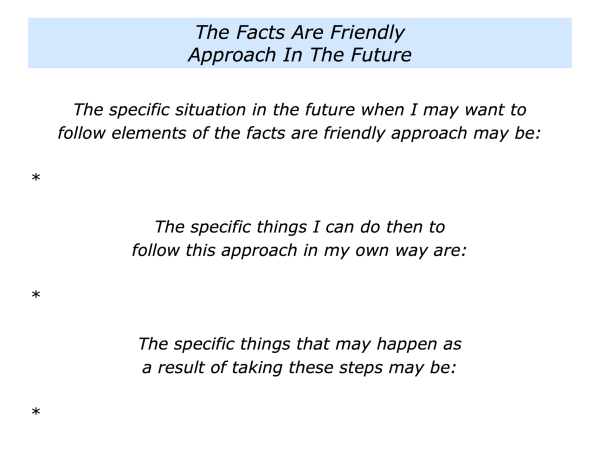
Let’s return to your present life. Looking ahead, can you think of a potentially tough situation where you may need to gather all the facts to make a good decision?
How can you embrace the attitude that the facts are friendly, even if some are uncomfortable? How can you choose your way forwards? How can you keep doing reality checks? How can you build on what is working and find solutions to any other challenges?
If you wish, try tackling the exercise on this theme. This invites you to complete the following sentences.

Leave a Reply